AI cold email is silently killing deliverability. The eight rules that keep AI outbound out of spam and into the inbox in 2026.
AI cold email is silently killing your deliverability
Most teams running AI cold email at scale do not realise the damage until it is too late. A campaign starts at 4% positive reply rate. Two weeks in, it slips to 2%. A month in, it is at 0.8%. The team blames the prompt. The actual problem is inbox placement.
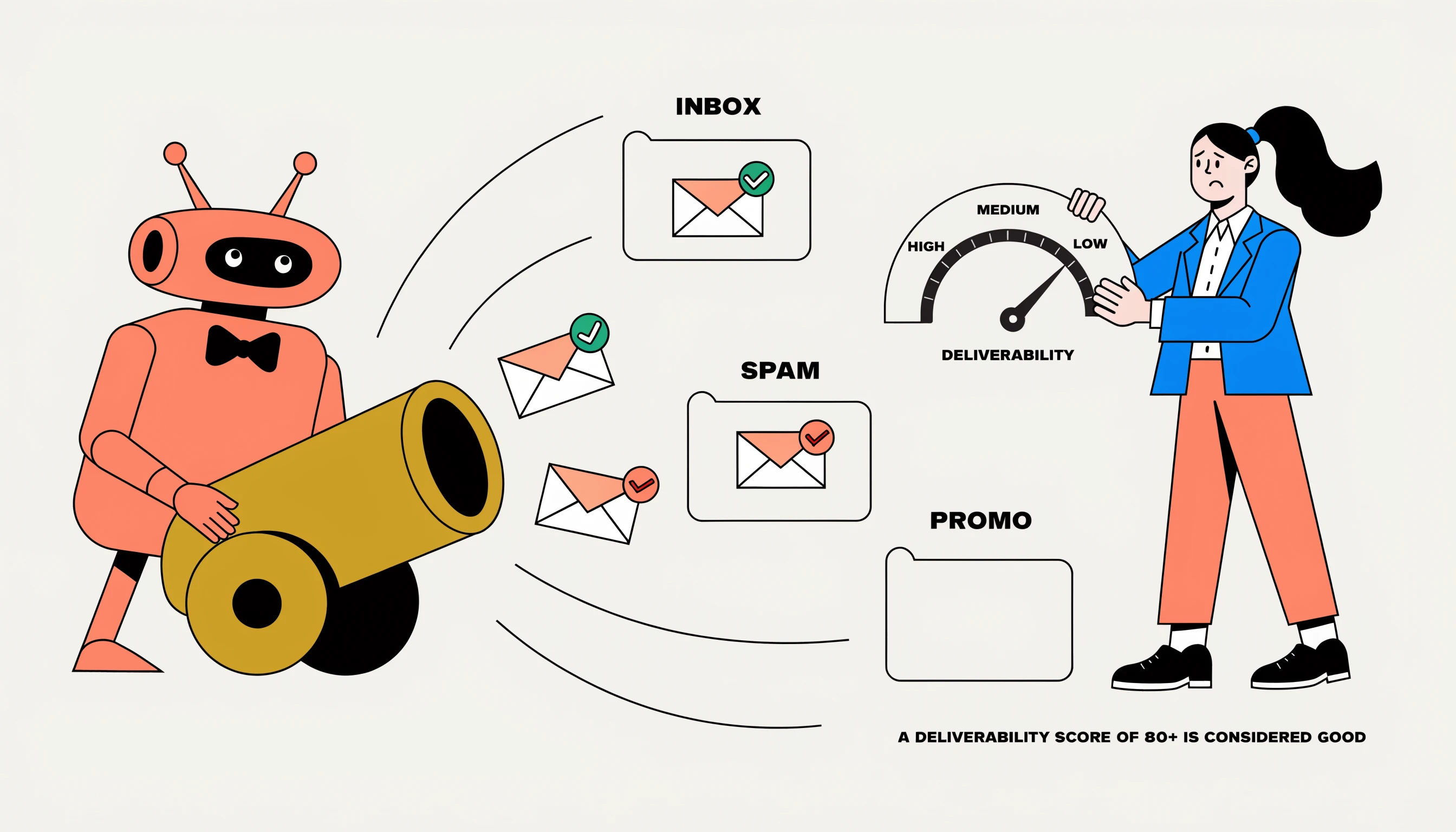
AI does not directly hurt deliverability. The way AI is run usually does. Volume increases. Pattern consistency increases. Spam triggers AI-generated copy creates increase. All three quietly push your domain from inbox to promotions to spam.
This is the deliverability guide for teams running AI outbound. We run AI cold email at scale for clients at Built For B2B with sub-1% bounce rates and sub-0.1% spam complaint rates. Below is how.
Why AI cold email is uniquely risky for deliverability
Three structural reasons. None are obvious until you look at the data.
1. AI scales volume faster than infrastructure can warm
A team gets excited about AI personalisation and pushes from 1,000 sends a week to 10,000 in 30 days. Domains were warmed for 1,000. The new volume blows past inbox provider trust limits. Gmail starts throttling. Microsoft starts filtering to junk.
The math. Each Google Workspace mailbox handles 40 to 60 cold sends per day safely. Push past 60 and Gmail starts watching. Past 100 and they start filtering.
2. AI output has detectable patterns
Inbox providers have AI detection models. They look for the same phrases ChatGPT produces by default. "I wanted to reach out." "I hope this finds you well." "Let me know if this resonates." When a domain sends thousands of emails containing the same AI tells, the spam filter pattern-matches and downgrades placement.
3. AI personalisation creates rendering quirks
AI sometimes generates weird Unicode. Curly quotes that do not render. Em dashes (which Built For B2B never uses anyway for brand reasons). Stray HTML entities from prompt outputs. Inbox providers see these and weight the sender as low-quality.
The deliverability benchmarks that matter
Forget open rate. Apple Mail Privacy Protection inflates it by 20 to 40%. It is meaningless.
The real benchmarks.
Bounce rate: under 2% (Google, Microsoft and Yahoo all enforce this since 2024)
Spam complaint rate: under 0.1%. Hit 0.3% and Google bulk-sender rules trigger hard rejection
Positive reply rate: 3 to 8% on cold lists
Sender reputation score: 80+ on Google Postmaster
Domain authentication: SPF, DKIM, DMARC all aligned
Microsoft tightened its rules in May 2025. Any sender pushing more than 5,000 emails a day must have SPF, DKIM and DMARC properly aligned or messages go straight to junk.
How to monitor deliverability while running AI
Three free tools. Use them weekly.
Google Postmaster Tools
Connect every sending domain. Track reputation, spam rate, IPv4/IPv6 reputation. If any score drops below "Medium", pause and diagnose.
Microsoft SNDS
Track Outlook inbox placement. Outlook inbox placement declined 22% in 2025 vs. Gmail 5%. SNDS shows the truth.
Mail Tester
Run a spam test from any new sending mailbox before sending live. Score under 8 out of 10 means you have a problem.
For paid tools, GlockApps and Mailreach are the standard.
How to set up AI cold email without killing deliverability
Eight rules. We run these on every client campaign.
1. Warm new domains for 4 to 6 weeks before AI sends
New domains take 3 to 4 weeks at minimum to build sender reputation. Brand new domains need 4 to 6 weeks. Use Warmbox or built-in warmup in Smartlead.
Warming during the campaign is too late. Warmup ramps trust. Production sending consumes trust.
2. Cap each mailbox at 40 to 60 sends per day
This is the universal rule. AI does not change it. If you need to scale to 5,000 sends a day, you need 100 mailboxes, not one mailbox sending more.
Buy domains in pools of 10 to 30. Set up 3 inboxes per domain. Spread risk.
3. Authenticate everything
SPF, DKIM, DMARC. All three. Set DMARC to p=reject for production sending.
Use DMARC.org guides if you are new to this.
4. Validate every email before sending
Use NeverBounce or ZeroBounce. Send rate to invalid emails must stay under 2%. AI lists are particularly prone to invalid emails because the AI sometimes guesses.
5. Run a banned-phrase filter on AI output
Before any AI-generated email goes out, scan for spam triggers and AI tells. Common offenders:
"I hope this finds you well"
"Just wanted to reach out"
"Free", "guaranteed", "100%", "urgent" in subject lines
All caps in subject lines
More than two exclamation marks
We run a Python regex filter on every campaign. Any output containing a banned phrase gets regenerated. The wider voice training playbook is in our AI voice training guide.
6. Rotate prompts every 60 days
Spam filters learn patterns. Your top-performing AI prompt today produces emails that get filtered in three months. Rotate prompts before performance degrades, not after.
7. Keep complaint rate under 0.1%
The single most damaging metric. Spam complaints tell Google your sender is unwanted. One complaint per 1,000 is 0.1%. Above that, deliverability tanks.
The fix. Suppress aggressively. Anyone who unsubscribes, bounces, or marks spam goes into the global suppression list across all campaigns. Never re-email them.
8. Use the right sender infrastructure
Google Workspace or Microsoft 365 for the mailboxes. Smartlead or Instantly for sending and warmup. Custom SMTP relays are tempting but mostly fail. Mainstream infrastructure has the best deliverability.
The deliverability damage AI tools can do
We have audited campaigns where AI tools actively damaged deliverability.
Case 1: shared sending infrastructure
A team used an AI SDR vendor that sent through their own pooled IPs. The pool was shared with hundreds of other senders, many of them low-quality. The team's domain reputation tanked despite their own emails being clean.
Fix: use Smartlead or Instantly with your own mailboxes on your own domains.
Case 2: AI hallucinating wrong contacts
A team using a pure AI list-builder ended up with a 15% bounce rate because the tool was guessing emails. Three weeks of sending and the domain was on Google bulk-sender block list.
Fix: validate every email through NeverBounce before sending. Drop any "guess" matches.
Case 3: AI generating subject-line spam triggers
A team let AI generate subject lines without filtering. The AI loved adding "FREE" and "URGENT" and excessive question marks. Spam complaints hit 0.4% in three weeks. Google blocked bulk sending.
Fix: lock subject lines to a human-approved library. Never let AI generate subject lines without review.
The relationship between AI volume and deliverability
A simple chart from our client data. Reply rate vs. send volume per mailbox per day.
20 sends/mailbox/day: 5.5% positive reply
40 sends/mailbox/day: 4.8% positive reply
60 sends/mailbox/day: 3.9% positive reply
80 sends/mailbox/day: 2.1% positive reply
100 sends/mailbox/day: 0.9% positive reply
Reply rate falls off a cliff past 60 sends/day. Inbox providers throttle. Buyers receive fewer of your emails. The AI is fine. The math is just against you.
The lesson. AI does not let you bypass the 50/day rule. AI lets you scale horizontally (more mailboxes), not vertically (more per mailbox).
What happens when you ignore this
The pattern is predictable. We have seen it across audits.
Week 1 to 2. Reply rate at 4%. Team is happy. Volume ramps.
Week 3 to 4. Reply rate at 2.5%. Team adjusts the prompt. No improvement.
Week 5 to 6. Reply rate at 1%. Bounce rate up to 5%. Microsoft inbox placement collapses.
Week 7 to 8. Domain on suppression lists. Replace the domain. Start over.
The fix at week 8 is the same as the prevention at week 0. Warm domains. Validate emails. Cap volume per mailbox. Filter AI output. Authenticate everything.
The clients we have stood this up for
The deliverability stack below is the same one running on every client campaign. Two specific examples.
GT Global hit 4.2% positive reply rate across a 12,000-prospect security ICP. Bounce rate stayed at 1.1%. Spam complaint rate at 0.04%. That deliverability profile is why the campaign produced $1.3M of pipeline in 45 days. Lift the bounce rate to 3% and the same campaign nets half the meetings.
Global Ocean Logistics ran the same stack over two years and built $2M of ARR. Domain reputation never dropped below "High" on Google Postmaster across the full 24 months. The discipline is the deliverability.
Our deliverability stack
For reference. The stack we run for every client.
Domains: Google Workspace, 3 mailboxes per domain, warmed for 4 weeks
Sending: Smartlead
Warmup: Smartlead native warmup
Validation: NeverBounce on every list
Authentication: SPF + DKIM + DMARC p=reject
Monitoring: Google Postmaster, Microsoft SNDS, Mail Tester weekly
AI output filtering: custom Python regex filter on every generated email
Suppression: global suppression list across all client campaigns
This stack hits sub-1.5% bounce rates and sub-0.05% spam complaint rates. We covered the full deliverability fix path in our deliverability guide. The wider AI cold email approach sits in our AI cold email guide and tooling decisions are reviewed in our AI tools guide.
The bottom line
AI cold email and deliverability are not opposites. They can coexist. But AI amplifies the consequences of bad infrastructure. If your domains are not warmed, your authentication is weak, your validation is loose, AI will surface those weaknesses faster than manual sending ever did.
Run the eight rules above. Audit weekly. Treat deliverability as a constant discipline, not a one-time setup.
If you want this set up and operated for you, we run the full AI cold email and deliverability stack as a service. Book a strategy call.
Insights & Ideas
Explore Real Strategies, Trends, and Tips to Help Your Brand Grow.