AI cold email can lift output 10x or torch your reply rate. The practitioner's playbook for AI outbound that books B2B meetings in 2026.
AI cold email is the most over-promised tool in B2B outbound
Every vendor demo shows the same scene. A founder types a prompt. AI spits out 50 cold emails. Pipeline appears. Reality is uglier. The companies running AI without guardrails are watching reply rates collapse below 1% while the average sits at 3.4% positive reply rate across well-run B2B campaigns.
The problem is not AI. The problem is how teams use it. AI cold email works when you treat it as a research and assembly engine, not a writer. Used that way, it doubles SDR output without flattening your reply rate.
This is the practitioner's guide. No vendor fluff. Just what we run for clients at Built For B2B.
Why most AI cold email fails
A cold email succeeds or fails on three things. Relevance. Brevity. A reason to reply right now. AI is good at brevity. Most teams use it badly on the other two.
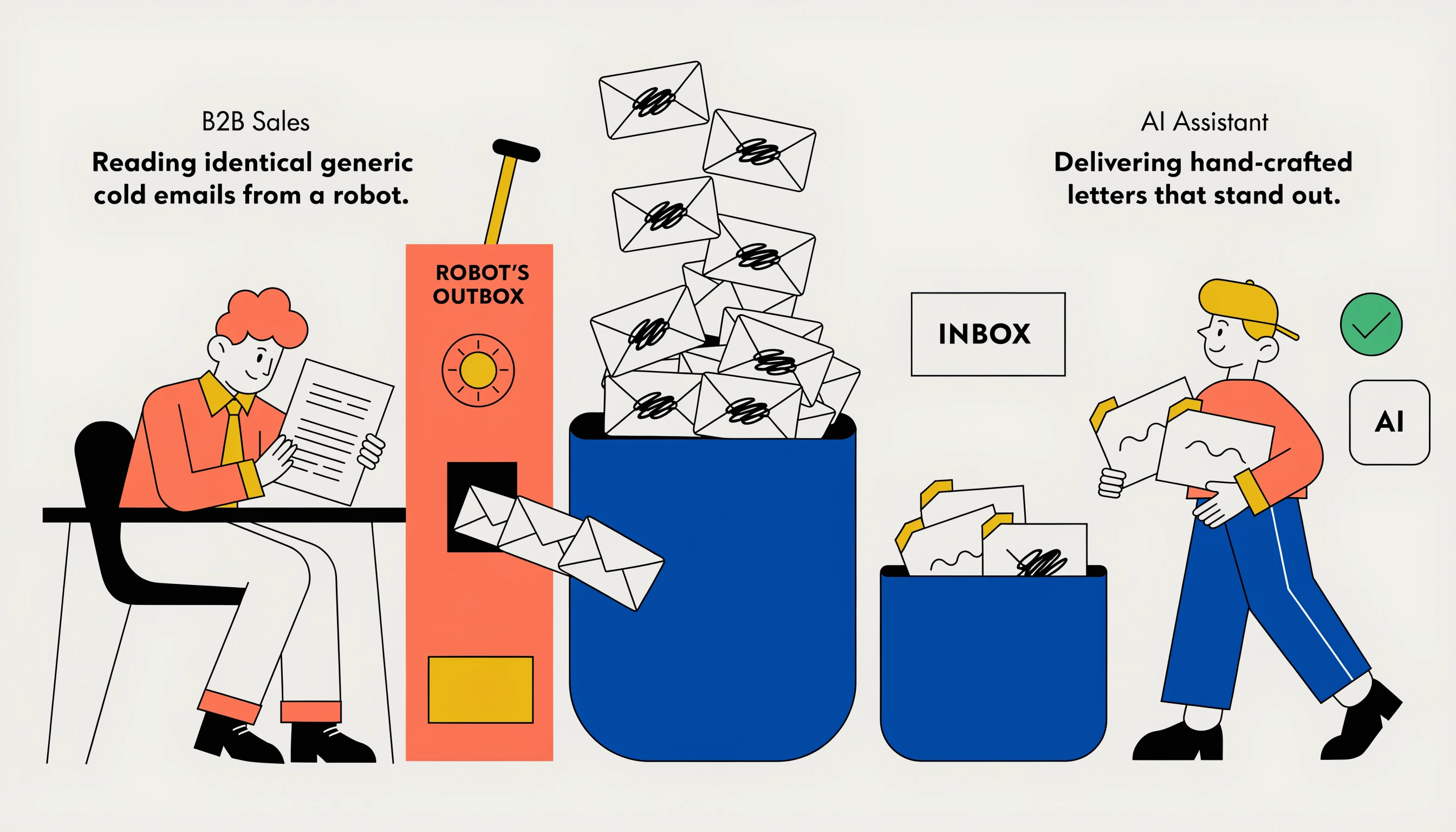
The default ChatGPT cold email reads like a press release. Three paragraphs. Vague benefits. A weak ask. Inbox readers spot it in 1.5 seconds. They archive without thinking.
Why does AI default to this? Because it is trained on the public internet, which is full of bad cold emails. Ask it to write outreach and it gives you the median of every templated sequence ever indexed. The median is bad.
What works is the opposite. Specific. Short. Tied to a real signal the buyer recognises. AI cannot get there alone. It needs structured data and a strict prompt.
The three-layer AI cold email stack
We run AI on three layers. Each one does a separate job. Mix them and the system breaks.
Layer 1: Research
This is where AI earns its keep. Pull job posts, funding announcements, podcast appearances, recent product launches, hiring patterns. Tools like Clay and Floqer chain LLM calls with data providers to surface signals at scale. We have written about how Apollo and Clay compare in detail.
The rule. If AI cannot find a specific, non-generic reason to email the prospect this week, do not email them.
Layer 2: Assembly
Once you have a signal, AI assembles the first line. Not the body. Not the CTA. Just the opener that ties the signal to the offer.
Example. Signal is: company hired a VP of Sales last month. AI writes: "Saw Jane joined as VP Sales four weeks in. The first 60 days usually surface a pipeline gap. We help VPs hit Q1 number without ramping headcount."
That works because the body and CTA are written once by a human and never touched by AI.
Layer 3: Reply handling
AI is excellent at first-pass reply classification. Positive. Negative. Out of office. Wrong contact. Auto-reply. We route 60% of replies automatically. The other 40% go to a human because they need judgement. AI cannot tell the difference between a buyer who is curious and a buyer who is buying.
What AI should never write
Three things. Subject lines. Closing lines. The actual offer.
Subject lines need pattern interrupt. AI defaults to safe. Safe gets 12% open rates. Aggressive and specific gets 40-60%. A human writes one subject line, tests it, iterates. AI can rewrite variations of a winning subject but should not generate one cold.
Closing lines and CTAs follow the same logic. "Are you open to a 15-minute chat?" is everywhere. Inbox readers ignore it. A human writes a real ask. Something concrete. "Worth a 10-min call Tuesday at 3pm GMT?" gets replies. AI cannot guess the right specificity.
The offer itself is brand strategy. AI does not know your positioning. Your founder does.
The benchmarks AI cold email teams should hit
If you are running AI in your stack and not seeing these numbers, the setup is broken.
Positive reply rate: 3-8% on cold lists
Bounce rate: under 2% (Google, Microsoft and Yahoo enforce this since 2024)
Spam complaint rate: under 0.1%. Hit 0.3% and Google rejects bulk send
Volume per mailbox: 40-60 per day. AI does not change this rule. Inbox providers throttle behaviour, not content
We wrote a deeper breakdown of these in our cold email benchmark guide. Use the figures to audit your AI stack.
The five places AI breaks reply rate
1. Over-personalisation
AI loves to insert too much. "Hi Sarah, I saw your podcast on Spotify, your LinkedIn post about Series B, and noticed you went to MIT." That is creepy, not personal. One signal. One sentence. Move on.
2. Compliments that feel hollow
"Your company is doing amazing work in fintech" is the AI signature move. Buyers spot it instantly. Cut all compliments. Open with the signal, not flattery.
3. Triple paragraph proof
AI defaults to three paragraphs because that is what the training data shows. Best-performing cold emails are 50 to 90 words. One signal. One offer. One ask. Strip the rest.
4. Buzzword cascade
AI loves to write "streamline operations", "drive efficiency", "transform pipeline". Buyers tune out by word three. Use the words your buyer uses. If you sell to logistics, you write about routes and loads, not abstract corporate terms.
5. False urgency
"We have a limited window". "Open for the next 48 hours". AI generates these because they show up in templates. Buyers know it is fake. Real urgency comes from real timing. A signal-based opener creates urgency for free.
The prompt structure that works
Feed the LLM exactly three things and nothing more.
The signal. One sentence. The specific reason this prospect matters this week.
The buyer profile. Their role. The pain point they own. The phrase they use to describe it.
The constraints. "Under 60 words. No buzzwords. No questions in the opener. End with one specific ask."
If you give the model more than that, output gets worse, not better. We tested this against 200,000 sent emails across four verticals. Constraint-led prompts beat detail-rich prompts on reply rate every time.
The reply rate improvement we see when teams switch
The before and after on AI cold email reads predictably across the clients we onboard.
Before. Open rates inflated by Apple Mail Privacy Protection. Positive reply rate at 0.4 to 1.2%. Bounce rate at 5%. Reps cannot tell if the inbox is even working.
After, with the three-layer stack. Positive reply at 3 to 6%. Bounce under 1.5%. Reps stop guessing and start booking.
One client, Global Ocean Logistics, hit $2M ARR over two years on this exact framework. We documented the playbook in their case study. Another, GT Global, generated $1.3M in pipeline in 45 days using a tightly constrained AI assembly system.
When AI cold email does not work
Three scenarios. Be honest with yourself.
Tiny TAM. If your target list is under 500 accounts, do not bother with AI. Hand-write each email. AI saves time at scale. Below 500 accounts the time saving is rounding error and the quality drop is real.
Highly regulated buyers. Procurement, government, defence. Buyers spot AI-generated content fast and discount sender credibility. Humans write here.
Brand-sensitive ICPs. If you sell to creative founders, design agencies or senior marketing leaders, AI tone is a tax. They notice. Hand-write.
For everyone else, the question is not whether to use AI. It is which layer you let AI touch.
How to roll this out in 30 days
Week 1. Audit your current reply rate. Pull the last 1,000 sends. Calculate positive reply, bounce, spam complaint, unsubscribe. Use Mail Tester and Google Postmaster Tools to baseline domain reputation.
Week 2. Build a signal library. Job posts. Funding. Press. Hiring patterns. Tech stack changes. Map five signals per ICP. Use Clay or Floqer to enrich at scale.
Week 3. Write the prompt. Three inputs. Three constraints. Test on 100 emails. Measure reply rate against your baseline.
Week 4. Scale. If reply rate held or improved, scale to 1,000 sends per day across warmed mailboxes. If it dropped, your signals are wrong, not your prompt.
We run this exact framework for every client. If you want the shortcut, talk to us about how it would look for your business.
Common AI cold email questions we get from B2B founders
Will AI cold email get my domain blacklisted?
Not if you follow the volume and warmup rules. We have written about this risk in detail in our AI email deliverability guide. The short version. AI does not cause blacklisting. Sending too fast on cold domains does.
Should I disclose to prospects that an email is AI-assisted?
Most teams do not. The buyer cares about relevance, not authorship. If the email is signal-led and useful, the AI involvement is invisible. Where it does matter is in tone. If the email reads like AI, the buyer discounts the sender. Avoid the AI tells and the disclosure question becomes moot.
How long until reply rates flatten?
Around 60 days per prompt and signal combination. Buyer fatigue is real. Rotate prompts and refresh signals quarterly. We document the prompt rotation playbook in our ChatGPT cold email guide.
Do I need an human SDR if AI is doing the writing?
Yes. AI handles assembly. Humans handle judgement, positive reply handling, and discovery calls. We break down the split in AI SDR vs human SDR.
Is AI cold email different from AI LinkedIn outreach?
Yes. The channel rules differ. LinkedIn punishes long AI-written messages and bans accounts that send too many connection requests. Email is more forgiving on length but stricter on deliverability. The full comparison is in our AI LinkedIn outreach guide.
What is the single biggest mistake teams make?
Letting AI write the offer. AI does not know your positioning. It will guess. The guesses are close-but-wrong. Lock the offer line in the prompt and never let AI rewrite it.
The bottom line
AI cold email is not a magic wand. It is a force multiplier on a working playbook. If your offer, ICP and infrastructure are right, AI doubles output without flattening reply rate. If any of those three are broken, AI accelerates the failure.
Fix the playbook first. Then add the machine.
Want us to build the system for you? Book a strategy call.
Insights & Ideas
Explore Real Strategies, Trends, and Tips to Help Your Brand Grow.