The AI cold email tools that actually book meetings in 2026. Honest rankings on data, AI assembly, sending, and reply handling.

The AI cold email tool market is a mess
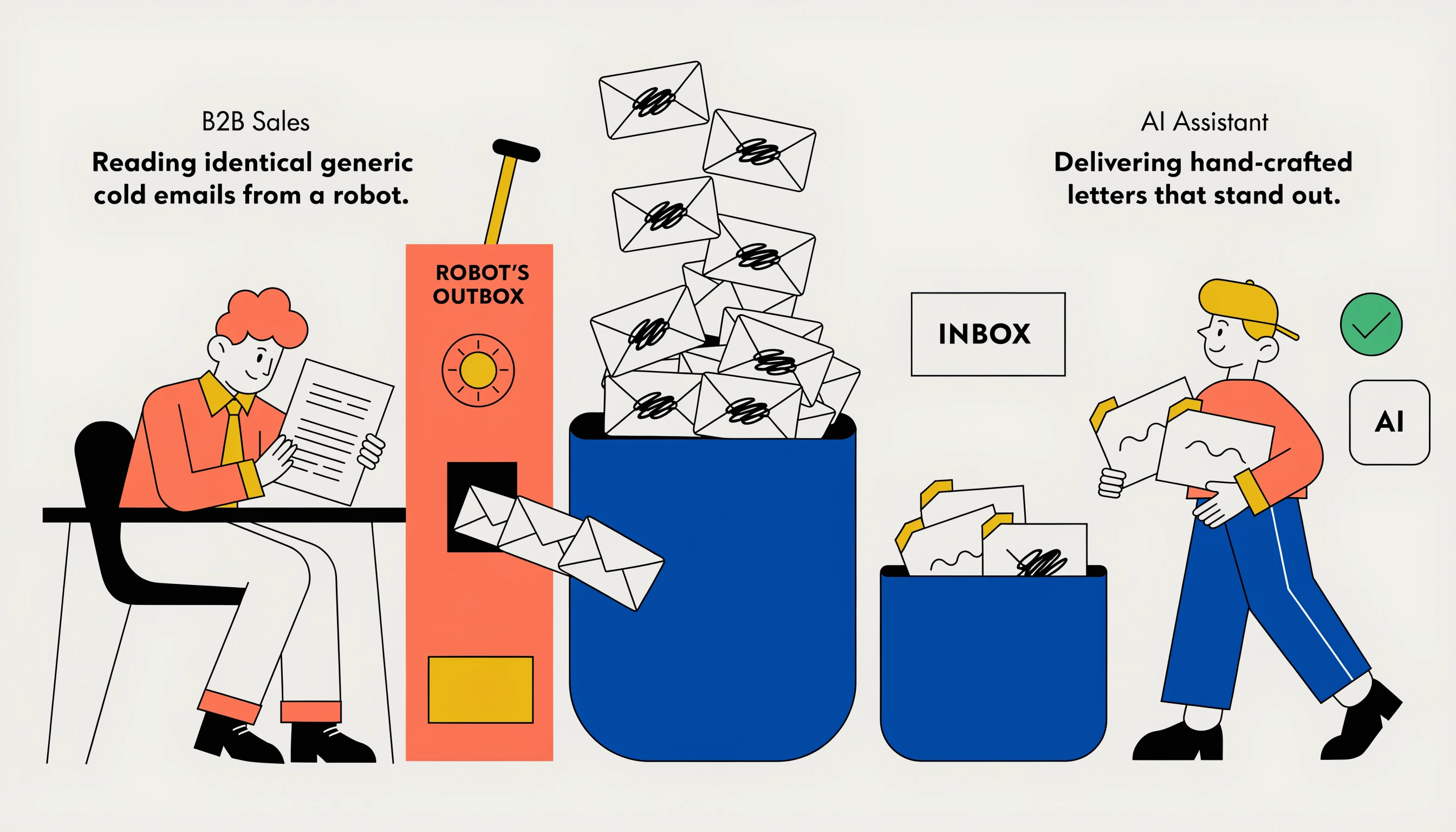
Every week a new AI cold email tool launches with the same pitch. "Write 1,000 personalised cold emails in 10 minutes." Reply rates do not back up the claim. We have tested 30+ tools across client campaigns in the last 18 months. Most of them lift volume and crash reply rate.
This is the honest review. We run client campaigns at Built For B2B and we have no skin in any vendor's game. Below are the tools that earn their place in the stack in 2026, sorted by job.
How to think about the AI cold email stack
AI does not replace one tool. It augments four jobs across the outbound stack.
Data and enrichment. Finding the right people. Surfacing intent signals.
AI assembly. Turning signals into opening lines at scale.
Sending and warmup. Getting emails into the inbox, not spam.
Reply handling. Classifying and routing inbound responses.
No single tool covers all four. Anyone telling you otherwise is selling you a demo, not a system. The teams hitting 3 to 8% positive reply rate run four to six tools chained together.
1. Data and enrichment
Your AI is only as good as the data you feed it. This is where most stacks fail.
Clay
Clay is the most powerful AI-native data tool in the market. Chain 75+ data providers with LLM calls in a spreadsheet interface. Pull funding rounds, hiring signals, tech stack changes, recent press, podcast appearances. The flexibility is unmatched.
The downside. Steep learning curve. Pricing changed in March 2026 to a dual credit system that surprises new users. Plans start at $185 a month and Growth runs $495.
Best for: agencies and in-house teams running 1,000+ accounts per campaign.
Apollo
Apollo is the workhorse. 275M+ contacts with verified emails. AI scoring filters down to ICP fast. Plans range from free to $119 per user/month.
The AI features added in 2025 are useful but not revolutionary. Contact discovery is the moat.
Best for: teams that need broad contact data fast and do not want to build enrichment workflows.
We compared the two in depth in our Clay AI vs Apollo AI breakdown.
Floqer
A cheaper Clay alternative with bring-your-own-key (BYOK) for LLMs. Less polished UI but the same chained AI workflow. Good for teams who already pay for OpenAI or Anthropic credits.
Best for: smaller teams who want Clay-style enrichment without the credit costs.
2. AI assembly
This is where AI writes the opener tied to your data. Three tools dominate.
Clay (again)
Clay's built-in AI fields handle most assembly tasks. You define the prompt, pipe in the enriched signals, and Clay outputs a personalised line per row. The AI is opinion-free, so the prompt design carries the load.
Smartlead AI personalisation
Smartlead added AI personalisation as a native feature in 2025. It pulls LinkedIn and website data and writes openers. The quality is mid-tier. It will not match a hand-tuned Clay prompt but it works for teams who do not want to manage a separate AI tool.
Lemlist Smart Enrichment
Lemlist added Smart Enrichment in late 2025. The UI is friendlier than Clay. The data sources are narrower. The output is good for top-of-funnel campaigns where signal depth is less important.
3. Sending and warmup
This is where reply rate is won or lost. AI does not help much with deliverability. Old-fashioned infrastructure matters more.
Smartlead
We use Smartlead across every client campaign. Unlimited mailboxes per workspace. Native warmup. Smart sending rules. Reply detection. The conditional sequences feature added in 2024 is best-in-class.
Plans start at $39 a month. We have written about how Smartlead compares to Instantly in detail.
Instantly
Instantly is the closest competitor. Strong sending. Better lead finder. Weaker reply management. Some teams prefer the UI.
In April 2025, Microsoft tightened deliverability rules for senders pushing over 5,000 emails per day, requiring SPF, DKIM and DMARC. Both Smartlead and Instantly handle this now. Test both before you commit.
Folderly
Folderly is an enterprise deliverability tool. Not for everyone. If your team is sending 50,000+ a month and you cannot get past Microsoft's filters, Folderly's monitoring and remediation justify the price.
4. Reply handling
AI shines here. Classification is a structured task LLMs are great at.
Smartlead AI Inbox
Built in. Classifies replies into interested, not interested, OOO, wrong contact. Around 85 to 90% accurate in our tests.
Custom GPT or Claude classifiers
For agencies and in-house teams running custom CRM workflows, building a classifier on the Anthropic or OpenAI API gives more control. We run a custom Claude-based classifier on Slack-routed replies for clients with non-standard sales motions.
Outreach.io and HubSpot AI assistants
Outreach and HubSpot have added AI reply assistants. Useful inside a wider sales engagement workflow. Overkill if you are running pure outbound.
What this stack delivers in real client campaigns
The tooling decisions only matter if they move pipeline. Two recent examples from our client roster.
GT Global: $1.3M in 45 days
We ran the four-tool stack (Apollo, Clay, Smartlead, custom reply classifier) for GT Global across their security ICP. The full breakdown is in the case study. Headline numbers. 12,000 signal-enriched prospects. 4.2% positive reply rate. 87 qualified meetings booked. $1.3M of net new pipeline created in 45 days.
The Clay enrichment was the load-bearing tool. Apollo gave us the list. Clay layered hiring and funding signals on every row. Smartlead delivered the sends. Without all three, the result is not reproducible.
Global Ocean Logistics: $2M ARR over two years
Same stack, longer runway. Global Ocean Logistics built $2M in ARR over two years on top of this exact tooling combination. The point is the stack scales from short-burst pipeline pushes to multi-year ARR plays.
A tool is just a tool. The system is the stack plus the workflow.
The stack we run
Here is the exact stack we run across most B2B client campaigns at Built For B2B.
Data: Apollo for contact discovery, Clay for enrichment and signals
AI assembly: Clay native AI fields with custom prompts per ICP
Sending: Smartlead, sometimes Instantly as secondary infrastructure
Reply handling: Smartlead AI Inbox plus custom Slack routing through our Reply Hub
This combination delivers the 3 to 6% positive reply rate we target. The exact prompts and signal libraries are different per client. The stack is consistent.
The tools we do not use and why
Standalone AI cold email tools (Lavender, Regie, Twain, etc.)
They are fine for individual SDR coaching. They do not replace a proper enrichment-and-sending stack. The pricing on a per-seat basis adds up fast and the value over a tight Clay prompt is marginal.
Most LinkedIn-to-email AI bundlers
These pitch a single dashboard for both channels. The integration is usually shallow. We have written about cold email vs LinkedIn outreach and the answer is run them separately with tools that specialise.
AI-only cold email writers without data
If the tool does not pull live signals, you are paying for slightly better template variation. Skip it.
What to look for when choosing AI cold email tools in 2026
Four questions filter most vendor pitches.
Does it pull live data? If not, the AI is writing from your CRM. That is not personalisation, that is mail merge.
Does it integrate with your sending tool? Standalone writers force you to export and import. That kills velocity.
Can a non-technical user run it? Clay has a learning curve. Smartlead is friendlier. Pick to match the team.
Does it move reply rate, not just open rate? Open rate has been unreliable since Apple Mail Privacy Protection rolled out. Demand the vendor share positive reply rate from real customers.
The cost of running this stack
A realistic monthly tooling cost for an in-house team running 5,000 sends per month.
Apollo Pro: $79 per user/month
Clay Growth: $495 per month
Smartlead Pro: $97 per month for 50 mailboxes
Domain and mailbox infrastructure (Google Workspace or Microsoft 365): $100 to $200 per month
Total: $770 to $870 per month for tooling. Add SDR time on top.
For most B2B companies, an outsourced agency runs the same stack for $3,000 to $8,000 a month including SDR labour and copy iteration. Our take on the cost trade-off is in our cost guide and our outsourced SDR breakdown.
Our recommendation
If you are starting out: Apollo plus Smartlead. Two tools. Around $176 per month. Enough to validate.
If you are scaling: add Clay for enrichment. Move to the four-tool stack above. Expect $700 to $900 per month in tooling plus labour.
If you are an agency or running 20+ campaigns: Clay plus Smartlead plus a custom reply classifier. Bring infrastructure in-house.
The AI cold email tools market will keep churning. The job-by-job framework will outlast any specific vendor.
A quick way to sanity-check any vendor before committing. Ask for two metrics from real customers. Positive reply rate over the last 30 days, and meetings booked per 1,000 sends. If they cannot or will not share both, walk away. Vanity metrics are easy to fake. Pipeline metrics are not. The stack we run earns its place because the pipeline metrics check out across dozens of campaigns. Demand the same from any vendor pitching you.
Want us to set up the stack for you? Book a strategy call and we will map your exact tooling needs.
Insights & Ideas
Explore Real Strategies, Trends, and Tips to Help Your Brand Grow.