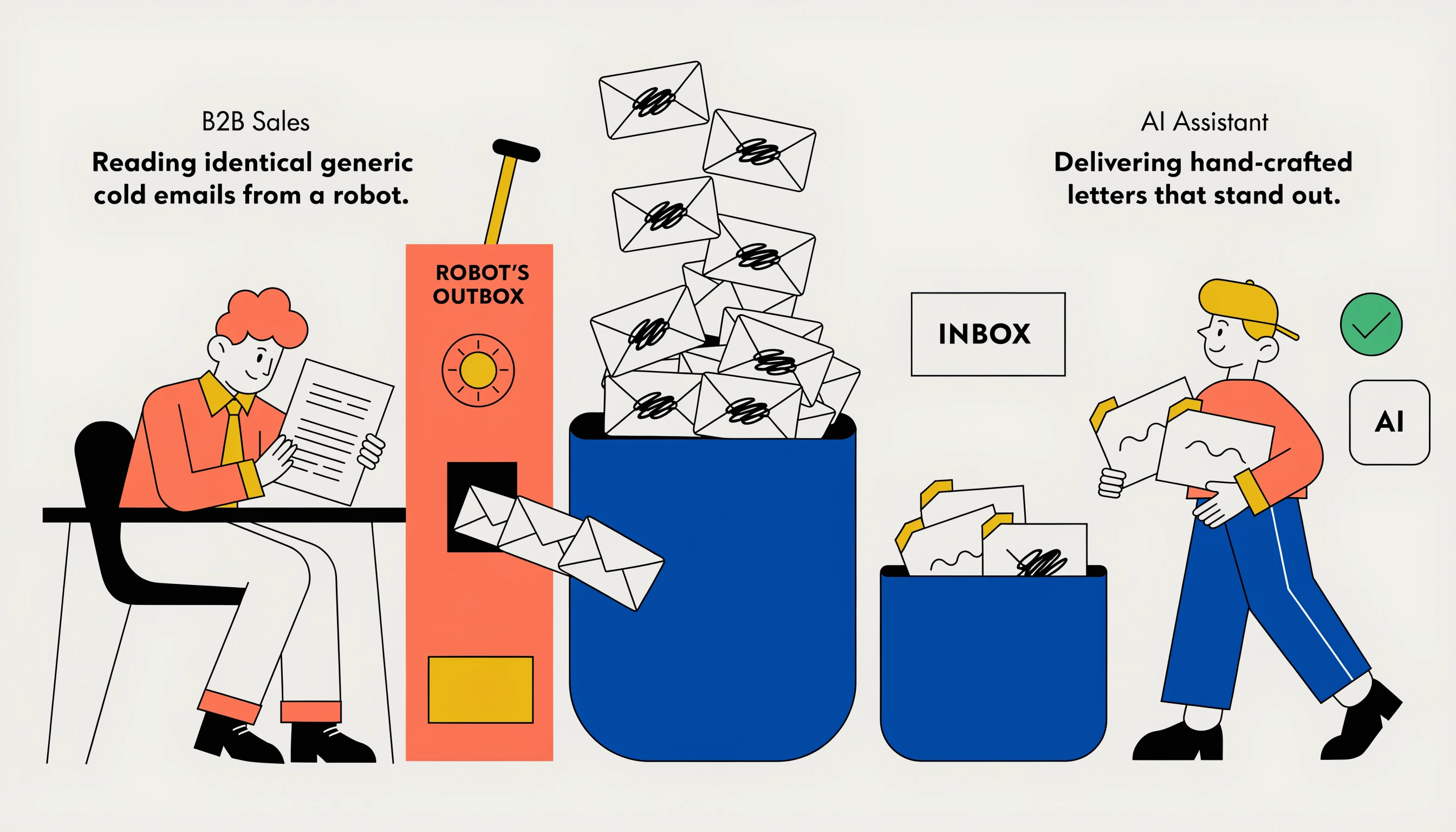
ChatGPT can write cold emails that book meetings, but only with the right prompts. The practitioner guide to prompts, constraints, and pitfalls.
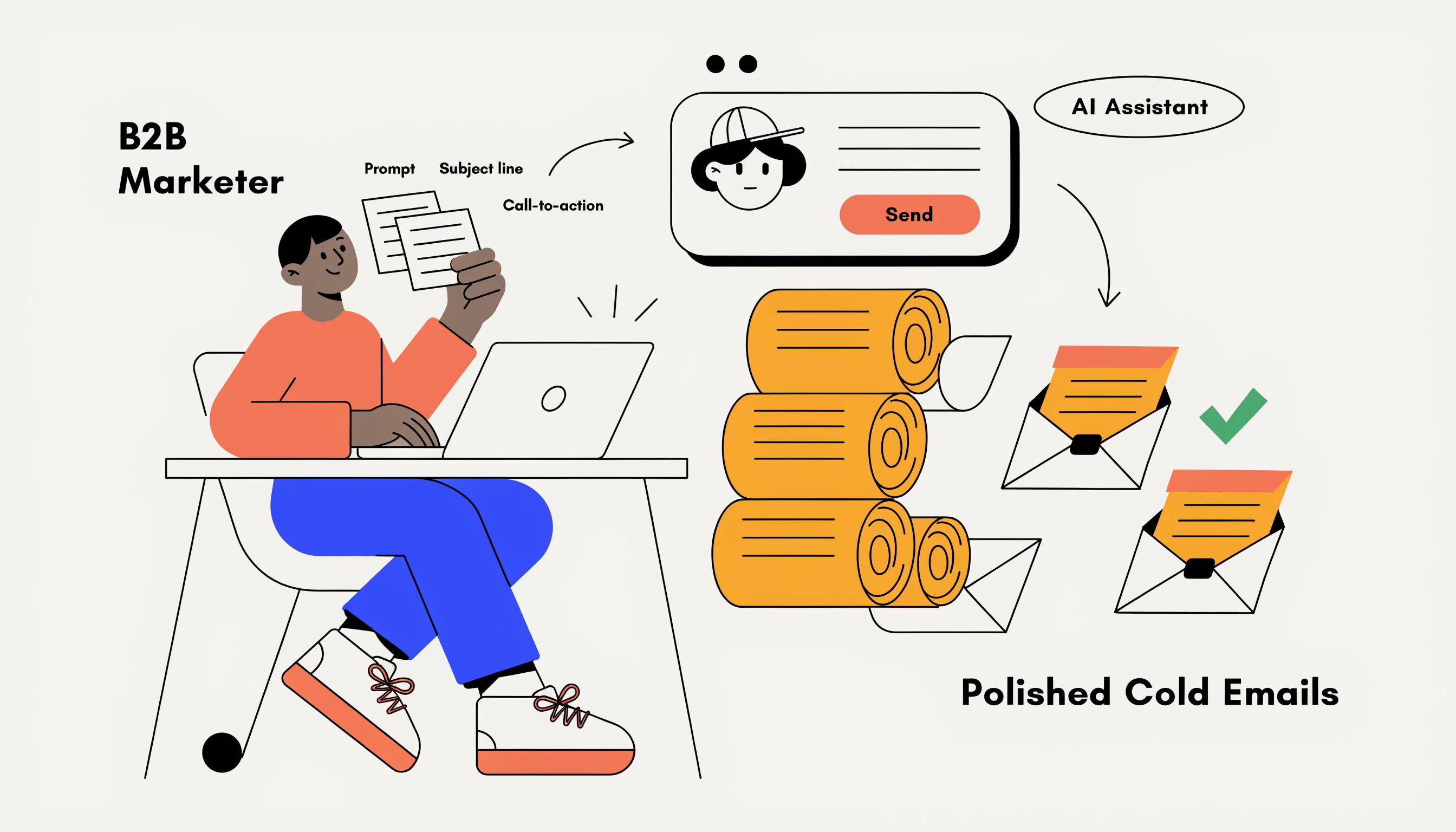
Most ChatGPT cold emails are dead on arrival
Founders ask ChatGPT to write a cold email. They get back three paragraphs about how the recipient's company is "doing amazing work" and the founder is "reaching out to set up a quick chat". The buyer archives. The founder tries another prompt. Same result.
The problem is not ChatGPT. The problem is the prompt. ChatGPT can write cold emails that pull 3 to 6% positive reply rates. The prompt has to do real work. Below is the playbook we run for clients at Built For B2B.
Why default ChatGPT cold emails fail
ChatGPT is a probabilistic text engine trained on the public internet. The internet is full of bad cold emails. Ask for a cold email with no constraints and you get the median. The median is bad.
Default output features five tells. Pattern these and you will spot them in your inbox today.
Opening compliment. "I have been following your company amazing work in fintech." Empty.
Long buildup. Three paragraphs before the ask. Buyers cut off at sentence two.
Vague benefit. "We help companies streamline operations and drive efficiency." What does that mean.
Generic close. "Are you open to a quick 15-minute chat next week?" Everyone says this. Buyers ignore it.
AI signature phrases. "Just wanted to drop a line." "Hope this finds you well." Tells the buyer a machine wrote it.
Fix these and reply rate climbs. The fix is in the prompt.
The five-part prompt structure
We use this exact structure across 200,000+ sends. It produces emails that hit 50 to 90 words, open with a signal, and end with a real ask.
Part 1: define the role
Start with one line that anchors the writer voice. Not "act as a marketer". Something concrete.
You are a B2B outbound SDR who has been writing cold emails for 8 years. You write short, direct, signal-led openers. You do not use compliments or buzzwords.
This stops ChatGPT defaulting to the "thought leader" tone.
Part 2: state the goal
One sentence. What outcome do you want.
Write a cold email that books a 15-minute meeting with the prospect.
Do not say "engage the prospect". Engagement is fluffy. Booking a meeting is concrete.
Part 3: provide the signal
This is the part most people skip. Without a signal, ChatGPT has nothing to anchor on and defaults to compliments.
Signal: the company posted a job for VP Sales 11 days ago. The job mentions the team needs to triple pipeline by end of Q2.
One signal. Specific. Recent. The signal library design is covered in our AI personalisation deep-dive.
Part 4: state the offer
What you sell, in the buyer language.
We are a B2B outbound agency. We book 30 to 60 qualified meetings a month for B2B SaaS companies using AI-led cold email and LinkedIn outreach.
Not "we help companies grow". Not "we accelerate revenue". Concrete output. Concrete channel.
Part 5: lock down the constraints
This is where most prompts fall apart. ChatGPT will pad without constraints. Lock the output down hard.
Constraints: under 70 words. No compliments. No questions until the final sentence. Final sentence is a specific ask with a time and date. No buzzwords. No greeting fluff. Plain English.
These seven constraints kill 90% of the bad defaults.
A full prompt and its output
Here is the prompt in one block. Copy it. Try it on your next campaign.
You are a B2B outbound SDR who has been writing cold emails for 8 years. You write short, direct, signal-led openers. You do not use compliments or buzzwords.
Write a cold email that books a 15-minute meeting with the prospect.
Signal: the company posted a job for VP Sales 11 days ago. The job mentions tripling pipeline by end of Q2.
Offer: we are a B2B outbound agency. We book 30 to 60 qualified meetings a month for B2B SaaS companies using AI-led cold email and LinkedIn outreach.
Constraints: under 70 words. No compliments. No questions until the final sentence. Final sentence is a specific ask with a time and date. No buzzwords. No greeting fluff. Plain English.
A representative output:
Subject: tripling pipeline by Q2
Saw the VP Sales role posted 11 days ago, with the brief to triple pipeline by end of Q2.
Most VPs we work with hit the number by booking 30 to 60 outbound meetings a month before headcount ramps.
Worth a 15-minute call Thursday at 3pm BST to see if the model fits?
That is 56 words. Signal-led. Specific ask. No compliments. No buzzwords. It works.
What to do with subject lines
ChatGPT is bad at subject lines because subject lines need pattern interrupt and ChatGPT defaults to safe. Use a separate prompt.
Write 10 subject lines under 6 words. Each one references the signal directly. No emojis. No clickbait. No questions. Plain English.
Test the top three across 300 sends each. Keep the winner. Throw the rest out.
The subject lines that perform follow a pattern. "Q2 pipeline". "30 meetings". "VP Sales hiring". Concrete. Curiosity-led. Under 5 words.
How to handle follow-ups with ChatGPT
The biggest gain in cold email is not the first send. It is sends 2, 3 and 4. Most reply rate comes from follow-ups. ChatGPT is excellent at follow-up generation when you give it the right context.
Follow-up prompt template:
This is follow-up email [number]. The original email referenced [signal]. The prospect has not replied. Write a 30 to 45 word follow-up that adds new value. Do not say "just following up". Do not repeat the original ask. Reference a new angle.
The "new angle" can be a customer result, a deadline, a new piece of context. We have seen GT Global's $1.3M pipeline in 45 days driven heavily by follow-up sequences built this way.
What ChatGPT cannot do
Four things you should never ask ChatGPT for in cold email.
1. The offer itself
ChatGPT does not know your positioning. It will guess and produce something close-but-wrong. Write the offer line yourself. Reuse it across thousands of emails.
2. The signal selection
ChatGPT cannot tell you which signals matter for your ICP. That is a strategic call. Choose the signals, then feed them to ChatGPT.
3. The list
ChatGPT will hallucinate companies. Use Apollo or Clay for the contact list. Never ask ChatGPT for prospects.
4. The CTA innovation
"Worth a 15-minute call?" works. ChatGPT will try to be clever with "could we hop on a quick chat". Lock the CTA in the prompt.
How to integrate ChatGPT into your sending workflow
The path of least resistance. Use ChatGPT through the OpenAI API directly inside Clay. Build the prompt once. Run it across 1,000 enriched rows. Export to Smartlead for sending.
The high-effort path. Write a few hundred manually using ChatGPT in the web UI. This is fine for ABM campaigns under 100 accounts. Not scalable above that.
We break down the wider tooling decision in our AI cold email tools guide.
How to QA ChatGPT output
Three checks before any send.
Read it out loud. If you would not say it in a meeting, do not send it in an email.
Cut every adjective. "Amazing", "incredible", "exciting", "world-class". Strip them. Verbs and nouns carry the email.
Time the read. The full email should read in under 15 seconds. If not, cut.
We also run a banned-phrase filter on every output. The phrases that disqualify a send include greeting fluff, "reach out", "touch base", "circle back". If any appear, regenerate.
Common ChatGPT mistakes that kill reply rate
Asking for personalisation without providing a real signal
Letting the model write the subject line at the same time as the body
Not specifying word count constraints
Using "warm and friendly" as a tone instruction (use specific constraints instead)
Sending without human review on the first 100 sends of any new campaign
How ChatGPT cold email compares to LinkedIn AI outreach
ChatGPT works on email and LinkedIn but the rules differ. Email forgives longer messages and 1,000+ sends per week per mailbox. LinkedIn caps connection requests at around 80 per week and the message length matters more.
We go deeper on the LinkedIn side in our AI LinkedIn outreach guide. The prompt structure is the same. The output is half the length. The CTA is softer.
If you are deciding which channel to start with, the broader email vs LinkedIn split is covered in cold email vs LinkedIn outreach. Most B2B teams should run both. ChatGPT can write for both with the same prompt skeleton.
We operate the channel split end-to-end via our LinkedIn outreach service alongside cold email.
The bottom line
ChatGPT is a fine cold email writer when the prompt does its job. Tight role. Specific signal. Hard constraints. A real offer. Without those, you are sending the same generic copy every other ChatGPT user is sending. With them, you can hit 3 to 6% positive reply rates at scale.
The prompt above is a starting point. Adapt it to your ICP and rotate it every 60 days as buyer fatigue creeps in.
Want us to build the prompt system and the sending infrastructure for you? Book a strategy call.
Insights & Ideas
Explore Real Strategies, Trends, and Tips to Help Your Brand Grow.