How to Book More B2B Meetings Without Hiring an SDR Team
Need more B2B meetings but can't justify hiring SDRs? Here are 4 proven methods to fill your calendar, from outbound to referrals, with real numbers.
4 Min Read
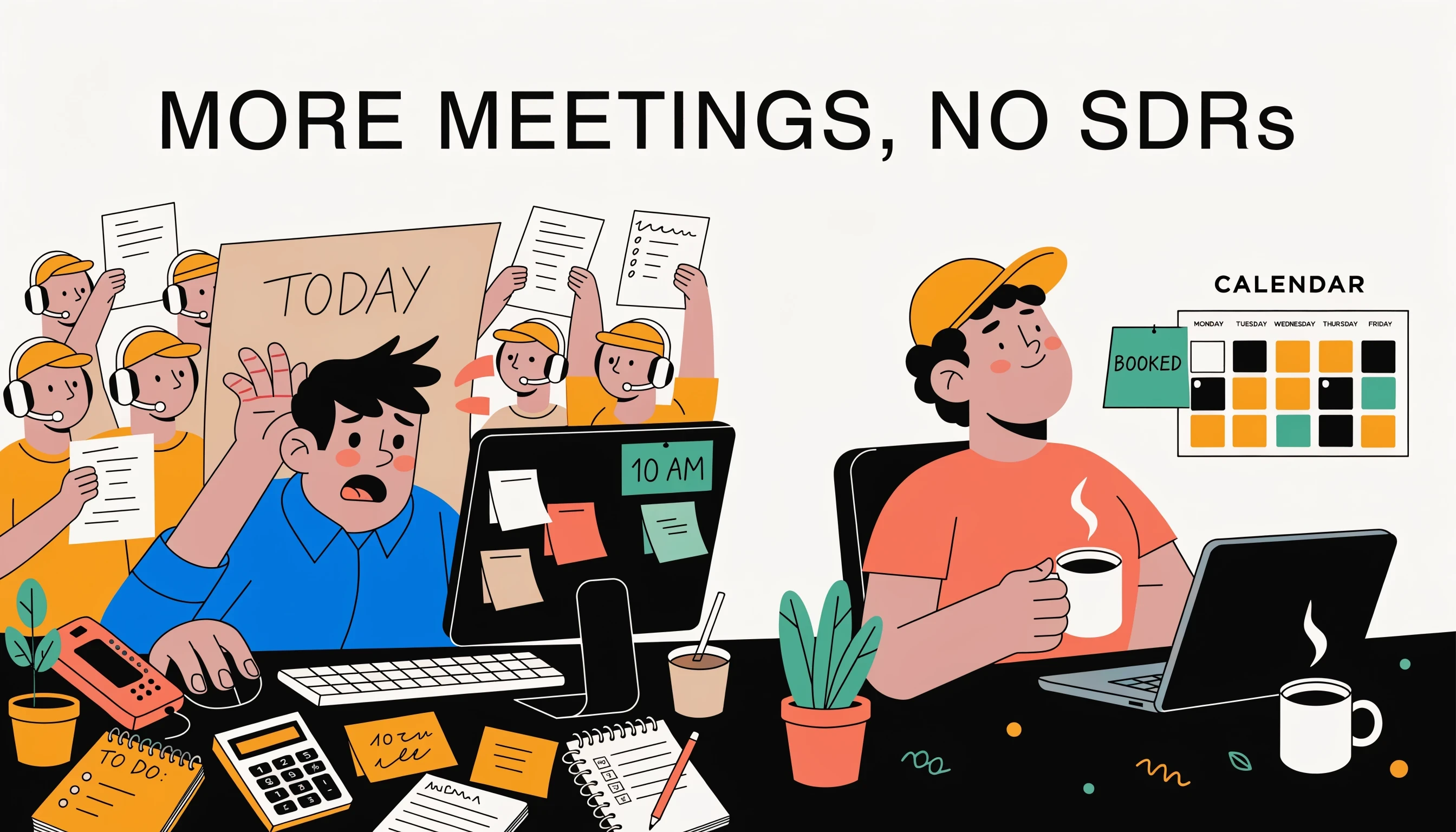
Your calendar is empty. Your pipeline is thin. You know you need more meetings with qualified prospects, but you are not ready to hire a full SDR team.
You are not alone. Most B2B companies between $500K and $5M in revenue face this exact problem. Too big to rely on founder-led sales alone. Too early to justify the $100K-$150K cost of an in-house SDR.
Here are four ways to book more B2B meetings without adding headcount.
Method 1: Outsourced Outbound (Fastest Path)
An outsourced outbound agency runs cold email and LinkedIn campaigns on your behalf. You get meetings booked directly into your calendar without hiring, training, or managing anyone.
How it works:
Agency builds your ICP and lead lists
Sets up email infrastructure (secondary domains, mailboxes, warming)
Writes and launches multi-step sequences across email and LinkedIn
Manages replies and books qualified meetings
Realistic results:
8-20 qualified meetings per month
Pipeline value of $100K-$500K+ per quarter
First meetings booked within 3-4 weeks of starting
What it costs: $3,000-$8,000 per month.
Real example: We booked Leaptree $320K in pipeline within 90 days from a standing start. No SDR hire. No 6-month ramp.
Best for: Companies that want predictable, scalable meetings without the overhead of hiring. This is our core service at Built For B2B.
Method 2: Founder-Led Outbound (Lean but Limited)
Before you outsource or hire, you can run outbound yourself. It is the cheapest option but demands your time.
How it works:
Sign up for a tool like Apollo or LinkedIn Sales Navigator
Build a target list of 200-500 ideal prospects
Write a 3-4 email sequence
Send 20-30 personalised emails per day
Handle replies and book your own meetings
Realistic results:
3-8 meetings per month
Requires 5-10 hours per week of your time
What it costs: $200-$500/month in tools.
The catch: It works, but it does not scale. You are trading your highest-value time (selling, product, strategy) for prospecting work. And without proper infrastructure, your deliverability will suffer as you scale.
Best for: Pre-revenue or early-stage founders validating their ICP before investing in a bigger outbound motion.
Method 3: Strategic Partnerships and Referrals
The highest-converting meetings come from introductions. A warm referral converts at 3-5x the rate of a cold email.
How it works:
Identify companies that sell to your ICP but are not competitors
Build relationships with their account managers and founders
Create a formal referral programme with clear incentives
Ask existing happy clients for introductions to peers in their network
Realistic results:
2-5 high-quality meetings per month
Very high close rates (40-60%)
Unpredictable volume
What it costs: Your time, plus any referral fees or reciprocal arrangements.
The catch: You cannot control the volume. Referrals are lumpy. Some months you get 5, some months you get zero. It is a supplement to outbound, not a replacement.
Best for: Companies with a strong existing client base and natural partner ecosystem.
Method 4: Content-Led Inbound (Slow Build, Compounding Returns)
Publish content that your ICP searches for. Rank on Google. Capture leads through forms, downloads, or direct enquiries.
How it works:
Research keywords your buyers search for (B2B marketing strategy, cold email best practices, etc.)
Publish high-quality blog posts targeting those keywords
Optimise for SEO
Include clear CTAs that drive to a booking page
Realistic results:
0-2 meetings per month in months 1-6
5-15 meetings per month after 12+ months of consistent publishing
Compounds over time (old posts continue generating traffic)
What it costs: Time to write, or $2,000-$5,000/month for an agency or freelancer.
The catch: Content takes 6-12 months to rank. It is a long game. If you need meetings this quarter, content alone will not get you there.
Best for: Companies building for the long term who want to reduce their dependency on outbound over time.
The Best Approach: Stack Multiple Methods
The companies that book the most meetings do not rely on a single method. They stack them:
Outsourced outbound for immediate, predictable meetings (weeks 3-4 onwards)
Referral programme for the highest-quality meetings (ongoing)
Content and SEO for compounding inbound over time (6-12 month payoff)
Founder outbound for strategic accounts that need a personal touch
This is the model we recommend to every client. Start with outbound for speed. Layer in referrals for quality. Build content for the long game.
What Realistic Meeting Numbers Look Like
Based on what we see across our client base:
Company Stage | Monthly Meetings Target | Best Method |
|---|---|---|
Pre-revenue / Seed | 5-10 | Founder outbound + referrals |
$500K-$2M revenue | 10-20 | Outsourced outbound + referrals |
$2M-$10M revenue | 20-40 | Outsourced + in-house SDR + inbound |
$10M+ revenue | 40+ | Full-stack (all methods) |
If you are in the $500K-$2M range and booking fewer than 10 meetings per month, you are leaving pipeline on the table.
The Bottom Line
You do not need an SDR team to book meetings. You need a system. Outsourced outbound gives you that system without the headcount, the management overhead, or the 6-month ramp.
We build these systems for B2B companies every day. $1.3M pipeline in 45 days. $500K+ revenue from a dormant database in 60 days. $2M ARR over 2 years.
Want to see what your meeting flow could look like? Book a strategy call and we will build a projection based on your ICP and market.
What a realistic meeting target looks like
Most founders set targets by wishful thinking. Work backwards from the arithmetic instead. One mailbox sends 40 to 60 emails a day. Ten mailboxes gives you roughly 500 sends a day, or 10,000 a month once you allow for weekends and warmup.
At a 3.4% average positive reply rate, 10,000 sends produces around 340 replies. Not all of those are interested. Expect a third to be genuine interest, which lands you near 100 conversations. Of those, 20% to 30% convert to a booked meeting. That is 20 to 30 meetings a month from a well-run programme.
If someone promises you 50 meetings a month off 5,000 emails, they are either buying lists you would not touch or counting every out-of-office as a lead. Ask them to show the arithmetic.
The three mistakes that keep calendars empty
First, sending from your primary domain. One spam run and your invoices stop reaching customers. Always buy secondary domains that redirect to your main site, and never send from the domain your business depends on.
Second, skipping warmup. Three to four weeks is the floor, and brand new domains need four to six. Skip it and you will spend the next quarter trying to repair a sending reputation you could have built properly in a month.
Third, chasing volume before message quality. Doubling your sends on a message that does not work simply doubles your complaint rate. Google rejects senders above a 0.3% complaint rate outright. Fix the offer first, then scale.
How long before meetings actually land
Two weeks to build and warm. Two to three weeks of sending before the pattern is clear. First meetings usually land inside 14 days of going live, but the reliable read on a campaign comes at day 60.
Judge on booked meetings and pipeline value, never on open rates. Apple Mail Privacy Protection inflates opens to the point of uselessness. If a report leads with open rate, it is hiding something.
Which channel books meetings fastest
Cold email scales further, LinkedIn converts warmer. Email lets you reach a few thousand people a month at a 3% to 8% positive reply rate. LinkedIn caps out around 100 to 150 connection requests a week per account, but well-targeted campaigns reply at 10% to 25%.
Run both against the same list and the compounding is obvious. A prospect who has seen your name in their LinkedIn feed replies to your email at a noticeably higher rate than a cold contact. The channels are not alternatives, they are sequence steps.
Keep LinkedIn acceptance above 30%. Below 20% and the platform starts restricting the account, which costs you weeks.
What to do before you spend anything
Write down who you sell to, with numbers. Company size, sector, country, job titles, and the trigger that makes them buy. If you cannot describe the buyer in one sentence, no amount of sending volume will save the campaign.
Then check your close rate on the meetings you already take. If you close under 10% of qualified calls, more meetings will not fix the business. Fix the sales conversation first, then turn on the tap.
Finally, decide who handles replies. Meetings die in the gap between an interested reply and a booked slot. Someone needs to own that inbox and respond within a few hours, every working day.
Common questions
How many meetings can I expect in month one? Usually a handful. Build and warmup take the first two weeks, so month one is a partial sending month. Month two and three are the honest test.
Do I need a big list? No. You need an accurate one. Two thousand verified contacts who match your buyer will beat fifty thousand scraped records every time, and they will keep your bounce rate under the 2% threshold providers enforce.
Can I run this myself? Yes, if you will own it daily. The work is domains, warmup, list building, copy, sending, and reply handling. Most founders start well and stall at reply handling, which is the step that actually produces meetings.
Put this to work on your pipeline.
We build and run cold email and LinkedIn outreach for B2B teams. From ICP definition to meetings in your calendar.