In-House SDR vs Outsourced: Which Builds Pipeline Faster
In-house SDR team or outsourced? We compare speed to pipeline, cost, quality, and risk. Real data from campaigns that generated $1.3M+ in pipeline.
5 Min Read
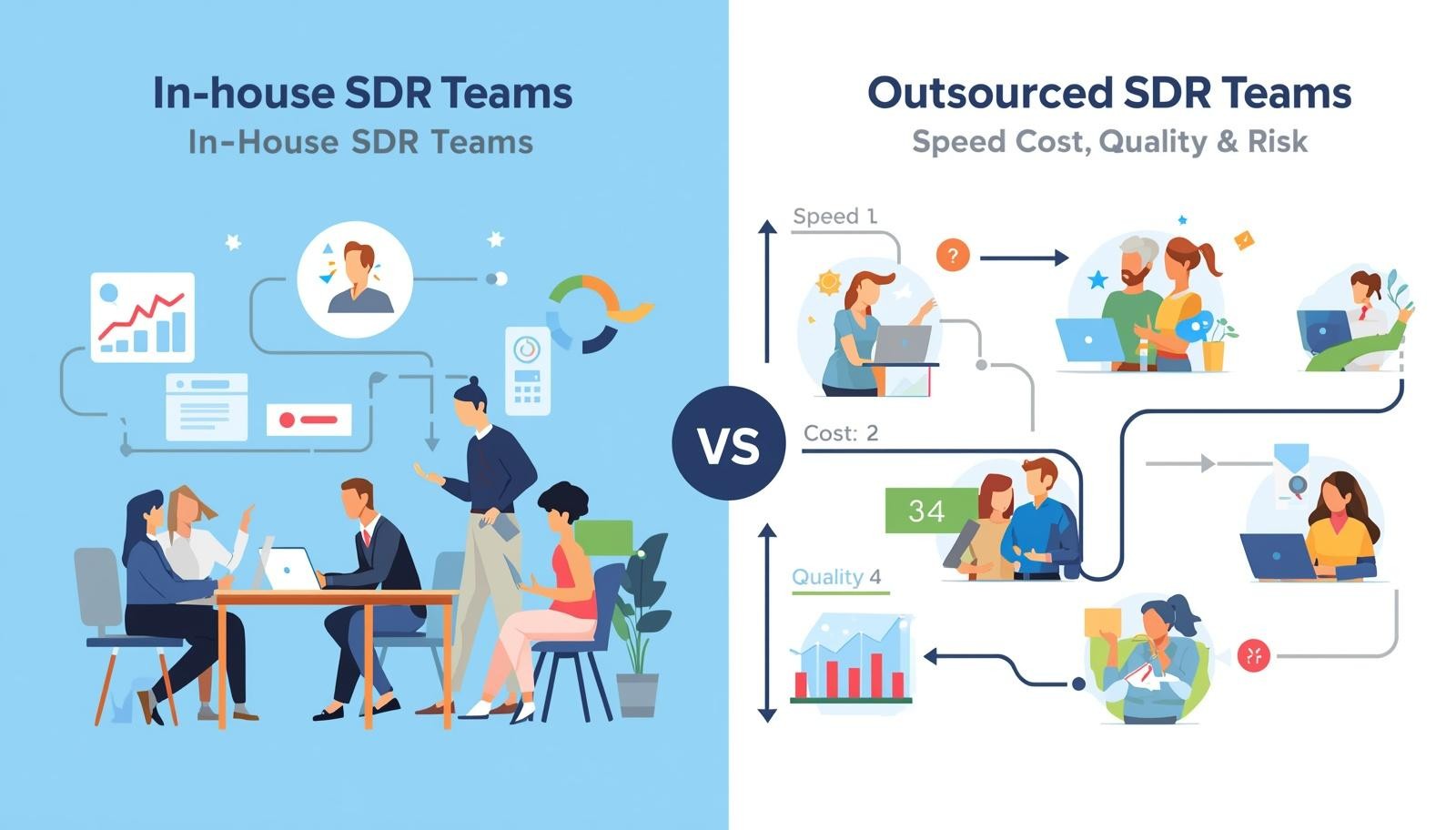
You need pipeline. The question is whether to build an internal SDR team or outsource the function to an agency.
This is not a theoretical debate. We have seen both models up close, built outbound engines for dozens of B2B companies, and watched founders waste six-figure budgets choosing the wrong path at the wrong time.
Here is a head-to-head comparison based on what actually happens, not what the sales training industry tells you.
Speed to Pipeline
In-house: 4-6 months minimum. You need to write the job spec, source candidates, interview, make an offer, wait for their notice period, onboard them, train them on your product, build their sequences, and wait for ramp. Most SDRs do not hit full productivity until month 4-6.
Outsourced: 2-3 weeks. A good agency already has the infrastructure (domains, mailboxes, sending tools, data sources). They spend week 1 on ICP definition and list building, week 2 on copy and sequence design, and launch in week 3.
We took GT Global Services from zero outbound to $1.3M in pipeline within 45 days. That is not an outlier. It is what happens when you skip the ramp.
Winner: Outsourced, by a wide margin.
Total Cost (Year One)
Cost Component | In-House SDR | Outsourced |
|---|---|---|
Base compensation | $55,000-$75,000 | $0 |
Variable pay (30-50% of base) | $16,000-$37,000 | $0 |
Benefits and taxes (25-35%) | $14,000-$27,000 | $0 |
Recruitment | $8,000-$20,000 | $0 |
Tech stack | $6,000-$18,000 | Included |
Management overhead | $14,000-$28,000 | Minimal |
Monthly retainer | $0 | $36,000-$96,000 |
Setup fee | $0 | $1,500-$4,000 |
Total Year 1 | $108,000-$205,000 | $36,000-$100,000 |
The in-house number does not include the cost of a failed hire. If your first SDR does not work out (and statistically, many do not), double the recruitment and ramp costs.
Winner: Outsourced. Even at premium agency pricing, the fully loaded cost is lower.
Quality of Output
This is where it gets nuanced.
In-house advantages:
Deep product knowledge after a few months
Tight feedback loop with AEs and product
Can handle inbound and warm leads alongside outbound
Builds institutional knowledge
Outsourced advantages:
Battle-tested playbooks from hundreds of campaigns
Multi-channel expertise (cold email + LinkedIn)
Better infrastructure and deliverability
Continuous optimisation without you managing it
No single point of failure (your rep quits, outbound stops)
A junior in-house SDR sending 50 emails a day from their primary domain will never match an agency running 500+ personalised touchpoints across email and LinkedIn with proper domain rotation.
Winner: Depends on your stage. Early stage and mid-market, outsourced wins. Enterprise with 12-month sales cycles, in-house can add more value.
Risk Profile
In-house risks:
Bad hire: 3-6 months lost, $40K+ wasted
SDR leaves after 14-18 months (industry average tenure)
Domain reputation damage from poor sending practices
Opportunity cost of slow ramp
Outsourced risks:
Bad agency: 1-3 months lost, $3K-$8K per month wasted
Less control over day-to-day execution
Dependency on external partner
Need to transfer knowledge if you bring it in-house later
The key difference: a bad agency costs you one month’s retainer. A bad hire costs you six months and five figures.
Winner: Outsourced. The downside is capped.
The Hybrid Path Most Companies Miss
The smartest B2B companies do not choose one or the other permanently. They sequence them.
Phase 1: Outsource. Let an agency build your outbound engine, test your messaging, validate your ICP, and generate initial pipeline. This takes 3-6 months.
Phase 2: Learn. Study what works. Which ICPs respond? Which messaging converts? Which channels perform? The agency’s data becomes your playbook.
Phase 3: Hire. Now bring in an SDR to execute the proven playbook. They ramp faster because they are not figuring things out from scratch. The agency already did the expensive experimentation.
Phase 4: Scale. Keep the agency running alongside your in-house team for additional channel coverage, or wind down the engagement and run internally.
This is how Leaptree built $320K in pipeline in 90 days. Outsource first. Learn what works. Then scale.
Decision Framework
Outsource if:
You have never done outbound before
You need pipeline in the next 30-60 days
You do not have a sales leader to manage an SDR
Your budget is under $130K for year one
You want to test outbound before committing to headcount
Hire in-house if:
You have a documented, proven outbound playbook
You are booking 30+ meetings/month and need to scale
Your sales cycle requires deep product expertise
You have a sales manager to coach and develop the rep
You can absorb 4-6 months of ramp time
Do both if:
You want to maximise channel coverage
You need speed now AND long-term capacity
You can invest in both without compromise
What to Do Next
If you are still reading, you are probably weighing this decision right now. Here is our honest advice:
Start with the real cost comparison. Map out what each option actually costs for your specific situation. Not the headline salary. The fully loaded number.
If outsourcing looks like the right move, book a strategy call. We will build a pipeline projection based on your ICP, show you what realistic results look like, and give you a clear plan before you spend a penny.
Further Reading and Industry Sources
For data on SDR ramp times, tenure, and quota attainment, see the Bridge Group SDR Metrics Report and the Salesforce State of Sales. For deliverability standards referenced throughout, see Google Postmaster Tools and Microsoft SNDS. Related reading: the best outsourced SDR agencies.
The ramp maths nobody runs
A new SDR is not productive on day one. Realistic ramp is 60 to 90 days before they hit consistent numbers. During that window you are paying full cost for partial output.
Take a UK base of GBP 45,000 with 35% variable on top. Add employer NI, pension, software seats, a data budget and a laptop. Fully loaded, year one lands between GBP 85,000 and GBP 150,000. Divide that by the nine or ten productive months you actually get and the true cost per productive month climbs sharply.
An agency retainer starts producing in weeks because the infrastructure, data and sequences already exist. You are buying a running system rather than building one.
What happens when an SDR quits
Median SDR tenure sits at 22 months in the Bridge Group data, and many teams see 14 to 18. When they leave, the domain knowledge, the sequences and the list logic often walk out with them.
Then you restart. Job ad, interviews, notice period, onboarding, ramp. Three to six months of reduced output before you are back where you were. That gap is the real cost of a bad hire, and it does not show up on the salary line.
When in-house genuinely wins
In-house wins when your sales cycle is long and highly technical, when the buyer expects deep product knowledge on the first call, or when you have enough inbound volume to keep a rep busy without cold prospecting.
It also wins at scale. Past roughly five reps with a manager who knows what they are doing, unit economics favour building. Below that, you are paying startup costs on a team too small to absorb them.
How to compare the two honestly
Compare on cost per qualified meeting, not on monthly cost. A GBP 5,000 retainer producing 25 meetings costs GBP 200 a meeting. An in-house rep on GBP 110,000 fully loaded producing 20 meetings a month costs GBP 458. Run your own numbers before you assume hiring is cheaper.
Then compare on time to first meeting. An agency with warmed infrastructure is sending in two weeks. A new hire is contributing properly at month three. In a year, that difference is a quarter of lost pipeline.
Finally compare on downside. If an agency underperforms you leave after the initial term. If a hire underperforms you manage them, then performance manage them, then replace them. That process takes months and management attention you may not have.
The hybrid that usually wins
Most companies below 20 staff should not hire an SDR first. Use an agency to prove the channel works, learn which messages land and which segments convert, then hire once you know what a good rep would be executing.
That order matters. Hiring first means paying someone to run experiments you have never run. Hiring second means handing them a proven playbook, which is a far easier job to succeed at and a far easier role to recruit for.
Common questions
Which is cheaper? Per meeting, an agency usually wins below five reps. Per year at scale, in-house usually wins. Run the cost per qualified meeting on both before deciding.
How long should I commit? Three months is the minimum sensible term for outbound, because warmup alone eats the first two weeks and campaign data is not reliable until day 60. Anything shorter tests the setup rather than the channel.
Can I do both? Yes, and many teams should. Use the agency for volume prospecting and new segments, and keep your in-house rep on inbound follow-up and the accounts that need product depth.
Put this to work on your pipeline.
We build and run cold email and LinkedIn outreach for B2B teams. From ICP definition to meetings in your calendar.